The state Department of Ecology and Alcoa are taking public comment on cleanup of the Ferndale site.
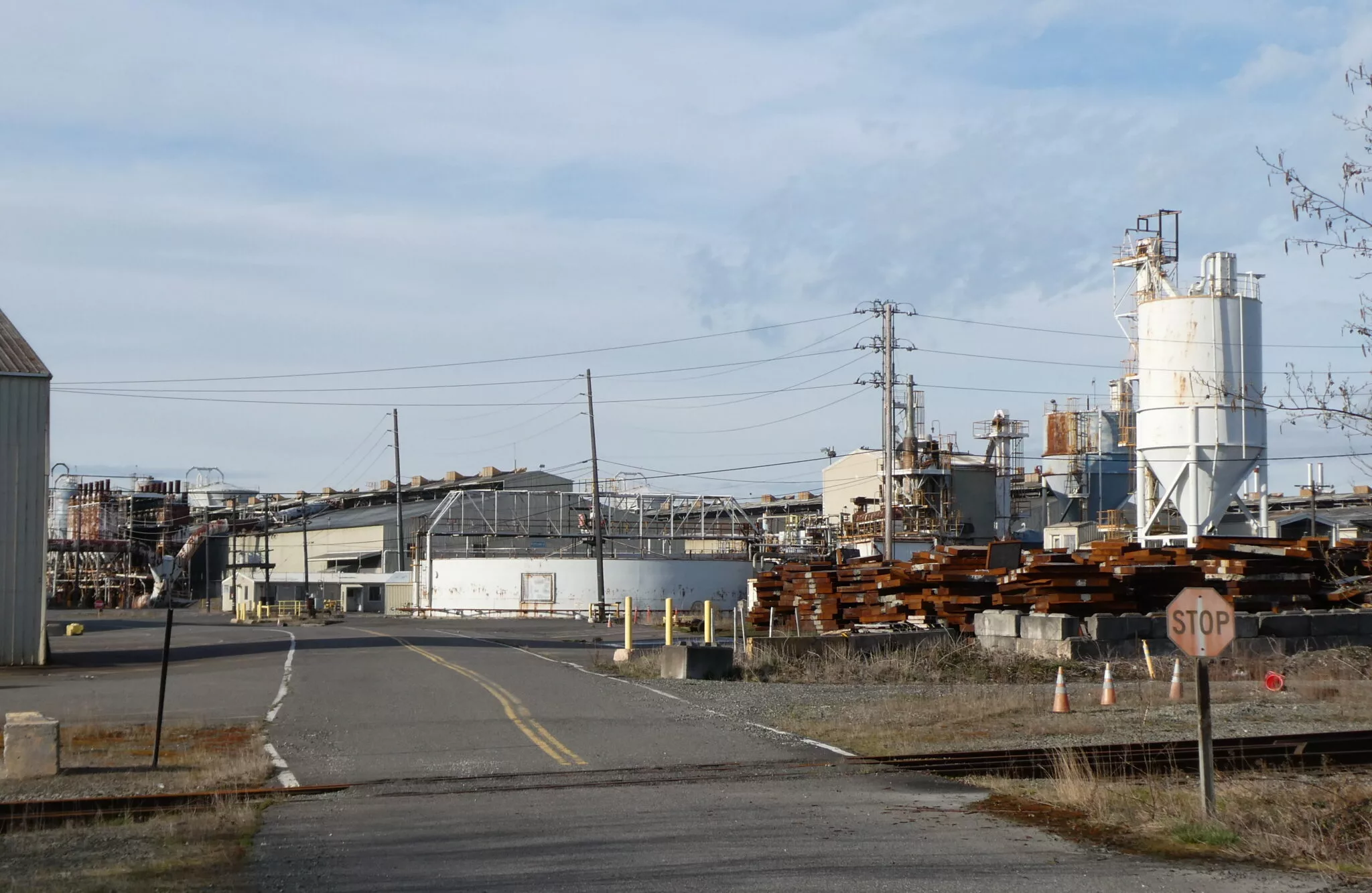
Aluminum maker Alcoa has started to demolish its sprawling Intalco smelter west of Ferndale. The multiyear demolition and cleanup project snuffs out any lingering hopes of reviving aluminum production in Washington and bringing back the hundreds of union jobs that disappeared when the smelter shut down in 2020.
The demolition also represents the curtain coming down on an industrial era in the Pacific Northwest. The Alcoa Intalco smelter was the last one standing of what were once 10 thrumming, energy-gobbling aluminum factories spread across the region.
Alcoa made no public announcement when it began the Intalco smelter demolition sometime last year. A company spokesperson confirmed the teardown is now well underway when queried this past week by Salish Current.
“We’re approximately 45% complete at this time,” the spokesperson said via email.
In late February, the state Department of Ecology published a long-awaited draft cleanup roadmap for the closed smelter. Ecology has tentatively scheduled an online webinar and public hearing for April 8 about the demolition and cleanup plan. The agency will also accept written public comments through April 15.
The Northwest aluminum industry arose in the 1940s after federal dams harnessed the Columbia River to produce a surplus of cheap electricity.
“Over time, the industry grew to employ around 11,000 people in the Northwest and consume 3,150 average annual megawatts of electricity, enough to light three cities the size of present-day Seattle for a year,” wrote Paul Harrison in a brief history of aluminum making in this region posted by the Northwest Power and Conservation Council.
But when the hydropower surplus gradually turned to scarcity beginning three decades ago, electricity prices increased and the vast aluminum smelters closed down one by one.
The Ferndale smelter was the next to last to open – in 1966 – and the last to shut down. Its forerunners spread out in Washington from Vancouver to Longview, Tacoma, Wenatchee and Spokane, and in Troutdale, Oregon, and Columbia Falls, Montana, as well as others. The massive plants churned out rods and ingots which would go on to be shaped into everything from soda cans to Boeing airplanes.
On the jobs review website Indeed, Intalco pot line operators described the work on the cavernous smelting lines as hot, dirty and physically-demanding. They complained about long hours, but praised the pay and the workplace camaraderie.

Alcoa mothballed its Whatcom County smelter in 2020 during a period of falling metal prices and later said the steep cost of needed equipment modernization precluded restart. The following year, Blue Wolf Capital offered to revive the smelter to make “green” aluminum with cut-rate hydropower, but that plan faltered when the requisite power could not be procured.
In 2023, Alcoa announced it had signed a contract to sell the 1,600-acre Intalco smelter site to Calgary-based energy company AltaGas. However, most of the property remains in Alcoa’s hands today pending the completion of the complex demolition and pollution cleanup.
Contamination extent uncertain
“As of right now, we’re still kind of in the investigative phase,” said Shingo Yamazaki, the refinery and smelter unit supervisor for the state Department of Ecology.
Based on other smelter cleanups and Alcoa’s hazardous materials tracking, Yamazaki said he expects they will need to deal with localized soil contamination from historic PCB spills and petroleum product leaks. He said he would also be unsurprised if groundwater testing detects fluorides.
“The questions I think that a lot of people have like, ‘What’s there? Where is it?’ I think a lot of those questions will probably be answered as we kind of thoughtfully go through that process,” Yamazaki said in an interview.
The Alcoa spokesperson in Pittsburgh emailed a statement that said, “This is an important milestone, as it will help to define the actions and activities that would be appropriate in the remediation process in support of the site’s highest and best use.”
Demolition and asbestos abatement started under a Whatcom County permit issued last year. The company told county planners that it would recycle as much as it could and would truck concrete debris offsite to be crushed and reused.
Alcoa’s proposed timeline given to Ecology said its contractor aims to tear down all the smelter buildings and alumina ore silos by the end of this year and complete any soil backfill and regrading sometime later in 2027.
One party likely to provide comments at the upcoming hearing is the Bellingham-based environmental group RE Sources.
“Intalco certainly was one of the biggest air and water polluting industries in Whatcom County for a long time,” Co-Executive Director Ander Russell said in an interview.
“It’s clear that there are some really dangerous levels of some really nasty contaminants, like PCBs and PAHs (industrial or fossil fuel byproduct), in the soil and in the groundwater,” Russell said. “They’re there. To some extent they’ve already been cleaned up.”
What does the future hold?
Aluminum smelters around the Northwest, including this one, are interesting redevelopment prospects in part because of the high-capacity electric grid connections left behind. Google built a big data center on the site of the former aluminum smelter in The Dalles, Oregon. Across the Columbia River in Klickitat County, a renewable energy developer has visions of building an energy storage complex using connected water reservoirs on the site of the former Goldendale Aluminum smelter.
The Canadian buyer of the Alcoa Intalco property previously announced it aspires to make green hydrogen on the site by using renewable electricity to split water molecules. But that redevelopment plan is on hold while multiple uncertainties swirl around the viability of hydrogen production and future customer demand for the fuel.
In an emailed statement, AltaGas said one thing its executives are watching is the outcome of a multistate lawsuit to overturn the cancellation of the federally funded Pacific Northwest Hydrogen Hub. The hub project would have funneled a taxpayer subsidy of around $100 million to AltaGas for the design, construction and startup of the planned green hydrogen factory.
“AltaGas remains interested in finding the right redevelopment opportunities for the Intalco lands, but any path forward must be responsible, feasible and aligned with both community values and regulatory certainty that comes with a clear and stable policy framework,” the company statement read. “We will continue to monitor developments closely and keep stakeholders informed as we reassess viable options for the site.”
The proposed green hydrogen production plant bears watching and could represent a step in a positive direction, said Russell of RE Sources.
“If it’s copacetic with the tribes, certainly we’d like to see more extensive clean energy development and I think hydrogen is part of the conversation,” Russell said.
About the Author